Showing posts with label Educational psychology. Show all posts

David Ausubel's Subsumption Theory

Friday, April 01, 2011

Ausubel receiving (or giving?) an "i dont know" award...hehehe...He is wearing glasses...
     
          It is a consensus among educators that experiential learning or hands on approach to learning is a very effective teaching strategy. John Dewey's "learning by doing" phrase had been used gazillion times especially by education students if asked what the best teaching strategy is. However, I just would like reiterate that to use this approach in teaching requires preparation and materials. And we can't just utilize this on everyday basis, as well as on simple objectives that do not necessarily require "experiential" activities. This is where expository teaching comes in.
          Expository Approach in teaching is the most common teaching strategy wherein the teacher explains the lesson to the pupils. This is different from Discovery Approach where the pupils discover for themselves what the concept is. Some refer expository approach as teacher-centered, traditional and "spoon-feeding". That this kind of approach is just giving the students everything and does not give them the chance to think. Perhaps this approach is sometimes blamed with low mastery and academic level of pupils.
        On the other hand, David Ausubel presented an idea that makes expository approach more meaningful using verbal or textual presentations. He proposed the use of?....of?...of?...any guess? hehehehe...Advance Organizers to aid for a more meaningful learning (LET alert: This always comes out in the exam). "These organizers are introduced in advance of learning itself, and are also presented at a higher level of abstraction, generality, and inclusiveness; and since the substantive content of a given organizer or series of organizers is selected on the basis of its suitability for explaining, integrating, and interrelating the material they precede, this strategy simultaneously satisfies the substantive as well as the programming criteria for enhancing the organization strength of cognitive structure." (1963 , p. 81).Tsk tsk tsk,,,why do I have to quote this, I'm having a nosebleed...hahaha... Seriously, in simpler terms, advance organizers are used preceding or prior to teaching/learning a new content that can be used by the learner to learn and understand the new content. It is a means of preparing the learner's cognitive structure for the learning experience about to take place. It is a device to activate the relevant schema or conceptual patterns so that new information can be more readily "subsumed" into the learner's existing cognitive structures.
      This is where "subsumption" comes in.David Ausubel's  Subsumption Theory is a theory which suggests that learning "is based upon the kinds of superordinate, representational, and combinatorial processes that occur during the reception of information." When new knowledge is created that is substantive and non-verbatim, and is related to existing knowledge, retention and learning are primed. Forgetting occurs when new knowledge becomes integrated into existing knowledge, and loses its individual identity. (Ausubel, 2010). Again, in simpler terms, subsumption theory is incorporating a new material to one's existing cognitive structure (sounds familiar uhuh? yes the answer can be found below), from the word itself "subsumption" or to "subsume". And order to do this, there has to be an existing material that provides a framework into which the new learning is related, to the previous information or concept the learner has. In simplest term, it represents learning as somewhat like a ladder. In order to learn a new material, there are prerequisites. You can't learn how to write if you don't know what the letters are. You can't cook sushi if you don't know about Japanese cuisine in the first place ( I included this because I'm hungry..hehehe). If no previous knowledge is available, advance organizers are presented in order to give learners a framework in order for the new information to be meaningful and be retained for recall and transfer.
          This theory is somewhat similar with some known concepts like Piaget's "schema" as well as Bruner's "spiral curriculum". 
        Ausubel is a proponent of deductive and expository teaching methods. That is why this theory is also called as Meaningful Verbal Learning.
        On my next post I will discuss further about advance organizers and specific examples of these organizers as well as the applications in classroom teaching and instruction.

Diversity of Learners

Tuesday, November 02, 2010

         
        Diversity of learners includes different areas that teachers must be aware of and be sensitive of if they wants to cater each learner's needs and interests. As teachers, it is important to consider how diverse learners are especially in planning for effective instruction.

Learning and Thinking Styles
  • refer to the preferred way an individual processes information
I.                    Sensory Preferences- individuals tend to gravitate toward one or two types of sensory inputs and maintain a dominance in one of the following types:
1.       Visual Learners
·         may think in pictures and learn best from visual aids like diagrams, illustrated textbooks, overhead transparencies, videos, flip charts and hand-outs
a.       Visual Iconic- prefer visual imagery like film, graphic display or pictures
b.      Visual Symbolic- prefer abstract symbolisms like written words or mathematical formula
2.       Auditory Learners
·         learn best through verbal lectures, discussions, talking things through and listening to what others have to say
a.       Listeners- remember things said to them and make the information their own
b.      Talkers- prefer to talk and discuss
3.       Tactile/Kinesthetic Learners
·         prefer “learning by doing”, benefit much from hands-on approach, actively exploring the physical world around them
II.                  Global-Analytic Continuum
1.       Analytic Learners- tend toward the linear, step-by-step processes of learning and see finite elements of patterns rather than the whole
2.       Global Learners- lean towards non-linear and tend to see the whole pattern rather than particle elements
Multiple Intelligences (Howard Gardner)
1.       Visual/ Spatial (Picture Smart)
2.       Verbal/Linguistic (Word Smart)
3.       Mathematical/Logical (Number/Logic Smart)
4.       Bodily/Kinesthetic (Body Smart)
5.       Musical/Rhythmic (Music Smart)
6.       Intrapersonal (Self Smart)
7.       Interpersonal (People Smart)
8.       Naturalist (Nature Smart)
Exceptionalities
       These refer to learners who are different in some way from the normal or average. Most of these learners require a lot of understanding and patience as well as special education and related services if they are to reach their full potential and development.
  1. Mental Retardation and Developmental Disabilities
  2. Learning Disabilities
  3. Intellectual Differences (Gifted and Talented)
  4. Emotional and Behavioral Disorders
  5. Visual Impairment
  6. Hearing Impairment
  7. Oral Communication Problems
  8. Orthopedic Impairments
Other Factors
  1. Gender
  2. Racial, ethnic or cultural background
  3. Socioeconomic status

Applications in Teaching and Learning Process
  1. Encourage learners to share their personal history and experiences.
  2.  Integrate learning experiences and activities which promote students’ multicultural and cross-cultural awareness.
  3. Aside from highlighting diversity, identify patterns of unity than transcend group differences.
  4. Communicate high expectations to students from all sub-groups.
  5. Use varied instructional methods to accommodate student diversity in learning styles and multiple intelligences.
  6. Vary the examples you use to illustrate concepts in order to provide multiple contexts that are relevant to students from diverse backgrounds.
  7. Adapt to the students’ diverse backgrounds and learning styles by allowing them personal choice and decision-making opportunities concerning what they learn and how will they learn from it.
  8. Diversify your methods of assessing and evaluating student learning
  9. Purposely, form small-discussion groups of students from diverse backgrounds: different learning styles, multiple intelligences, different cultural background, etc.
 (This was actually my report in one of my graduate school classes but I wasn't able to give it due to time constraints...hehehe)

Information Processing Theory

Saturday, July 24, 2010

     Information Processing Theory explains acquisition of knowledge in a step-by-step manner. Sometimes, this theory is said to be analogous to how a computer works. What is good about this theory is its being organized in presenting how information comes to our mind. It gives us a picture or a diagram about how we learn things and processes that take place inside our head.


The Three Primary Processes
I. Encoding. This when the information in our environment is being sensed, perceived or attended to.

II. Storage. After we encode the information, it is stored for either a short or long period of time depending on how we process or encode the said information.

III. Retrieval. The stored information is retrieved when needed in a certain task.

The Three Main Stages of Information Processing

1. Sensory Memory
          Human body perceives the environment through the senses. These sensations travel to the brain as electrical impulses or synapses. However, these electrical impulses or synapses must be translated in such a way that the brain can understand. This process is called transduction. Sensory Memory, the first main stage of information processing is affiliated with the transduction of energy.
In this stage, our mind holds the information for extremely brief period of time, since it receives a great amount of information more than it can hold or perceive. This is the reason why attention is very important on this stage. In order for the information to proceed to the next stage, that information must be attended to, or must be familiarized by the thinker. In addition, the duration is different among the senses, like auditory memory is more persistent than visual memory.

2. Short-Term Memory
          This memory is also called working memory because this refers to what we are thinking in a certain moment of time. This stage is created if we attend to an external information, a thought that popped in our head, or both.
The capacity of short term memory is said to be 5 plus-minus. This means that STM can hold 3 to 7 chunks or bits of information. The duration of the information while in the STM is dependent on how we organize or practice/repeat that information. Thus, organization and repetition, plus chunking or grouping, can help the information proceed to the next stage, that is the Long-Term Memory.

3. Long-Term Memory
          This is the final stage of memory wherein the information can be stored permanently until needed. Its capacity is limited and its duration is indefinite.


          Take note however that these stages are not like that of machines that once turned on, will do the process 1st step, 2nd step, 3rd step, so on and so forth. The processes are said to be controlled and regulated by an executive processing system, more popularly known as metacognition. Metacognition, in simpler terms, is "thinking about thinking"

photo credit: http://www.stephpalmer.co.uk/Cognitive/infomodel.gif

Lev Vygotsky's Sociocultural Theory

Wednesday, July 21, 2010

         This is really it. My post about Lev Vygotsky. Hehehe... Lev Vygotsky is one of the social constructivists, who believe the importance of social interaction in learning. Learning is seen as an interactive and interpersonal activity. Development will not be fully understood if the social and cultural contexts are not considered, hence the name Sociocultural Theory.

Our handsome man of the moment...Lev Vygotsky...applause!!! Woohooo!!!

The Role of Social Interaction
          According to Vygotsky, learners learn through social interaction. Socially interacting especially with knowledgeable adults like parents, teachers, older peers, etc, gives them the opportunity to acquire learning. The people that surrounds the learner contribute to learning because they are the ones who explain, model, assist, give directions and promote feedback to enrich learning. They also are the media in which learners learn the ways of thinking and behavior that make up culture.

Language
          Language plays an important function especially in social interaction. However, it also has an important role in developing the thinking activities inside the mind of the learners. Language, as Vygotsky puts it, serves as a mediator between the learners' mind and their environment. As learners communicate or perform interpersonal dialogues, these dialogues will develop into intrapersonal dialogues in which will later become inner speech. Inner Speech is a form of self talk that guides the learner's thinking.

Zone of Proximal Development
          Vygotsky advocates learning by doing. However, he added that learning by doing, together with social interaction will result to a more effective learning. In relation to this, the Zone of Proximal Development was introduced. This is the level at which a child finds a task too difficult to accomplish alone, but which he/she can complete with the assistance of an adult or older peer. To achieve this, scaffolding can be used. Scaffolding is the aid or assistance than enables learners to complete certain tasks that they cannot do on their own. However, scaffolding is not doing the task for the learners, rather the adult/instructor only serves as a tool for that adjusts the amount of guidance to fit the learners current level of performance. Example, if a child doesn't know how to tie his/her shoes, an adult can do scaffolding by tying the shoes half-done, then letting the child finish it.

Photo credits courtesy of google image search..hehehe...sorry I wasn't able to copy-paste the exact web-site...I hope I don't violate netiquette(not sure about the spelling) hehhehe...

Jerome Bruner's Constructivist Theory: Spiral Curriculum

Friday, June 18, 2010

     As a continuation of my previous post last time, I will discuss on Jerome Bruner's concept that is really dominant in schools but unknown to many---Spiral Curriculum. Have you ever noticed the books of elementary pupils from grades 1-6? Have you observed that the topics are just being repeated right? Although there are some new topics, there are topics that are being repeated all over again. This is also true not only in elementary, but also in high school and up to college.

     Constructivist's view of learning tells us that learners must be given opportunities to recount and reflect on their experiences in order to have foundations for their future and new learning. Furthermore, teachers must also base what they teach on the level appropriate for the learners. Adding these two important ideas, we can now give meaning to what spiral curriculum really is.

     Forgive me but I will just quote Corpus and Lucas's definition. According to them, spiral curriculum is revisiting the curriculum by teaching the same content in different ways depending on students' developmental levels. Now, I hope this answers why topics are repeated all over again, but with a level, complexity and difficulty appropriate to the learners. Through these repeating, recounting or revisiting of topics, learners will have a clearer and progressive understanding thus enhances learning.

Constructivism: Jerome Bruner's Constructivist Theory

Monday, May 31, 2010

  
  Please forgive me if my posts are in chunks. You know, I update my blog using only my cellphone. I don't have any laptop or a pc of my own. I repeated this how many times and I will say this again. For those of you who have an old or surplus laptop or pc, I will appreciate it very much if you can give it to me...wehehehe(half joke-half truth)

     I would like to tackle about one of the constructivist psychologists whose works are actually utilized in schools but unknown to some. Since I lack character spaces on my previous post, I wasn't able to discuss that there are 2 views of constructivism:cognitive constructivism and social constructivism. I will just discuss these later as I discuss each constructivist psychologist and his works.

     Our man of the moment is Jerome Bruner. He is under the cognitive constructivism school of thought which stresses individual and inner construction of knowledge. He has given us important concepts about learning which I will just discuss one by one.

I. Stages of Knowledge Representation
According to Bruner, knowledge representation develops in 3 stages: Enactive, Iconic and Symbolic.
1. Enactive. The first stage in which learning is based on hands on experiences of physical objects together with the consequences that go after. Knowledge is represented through senses. You may have noticed this among children who learn about the world through touching and manipulating objects, smelling flowers, tasting a fruit, etc. However, this doesn't mean that this type of representation is only for babies or young children. This could also mean manipulative learning of objects such as learning how to use a microscope, to ride in a bicycle, or practicing how to dance, to do stunts, or to play a musical instrument.
2. Iconic. Knowledge can now be represented using models and pictures. Learners know how to make mental images of their world. This can be seen on books full of brightly colored pictures that are being used to teach children.
3. Symbolic. Learners can think in abstract. So abstract terms and symbol systems can be used to represent knowledge like numbers, mathematical symbols, letters and language. This is the reason why most of the books in college do not have so many pictures compared to books used in elementary.

Images of these topics and better and more credible (why? does this mean mine isn't? hehehe) discussions are found in this link http://brunerwiki.wikispaces.com/

Educational Psychology: Constructivism

Sunday, May 30, 2010

"As long as there were people asking each other questions, we have had constructivist classrooms. Constructivism, the study of learning, is about how we all make sense of our world and that really hasn't changed"- Jacqueline Grennon Brook

Opening of classes is now near and it's been a long time since I last posted about educational psychology. My last post was about behaviorism and now I would like to discuss the, shall I say, opposite of it- constructivism.

Unlike behaviorism, constructivism deals with learning as an active process, internal or external. This proposes that students construct their own meaning and understanding about the world by experiences and reflecting on these experiences. Learners then try to reconcile their newly acquired experiences or ideas to the previous and old ones. In short, learners are the creators or active constructors of their own knowledge/learning. Learning is seen as interactive, and is grounded upon on what the students already know. The knowledge being acquired is considered as dynamic, always changing together with experiences.

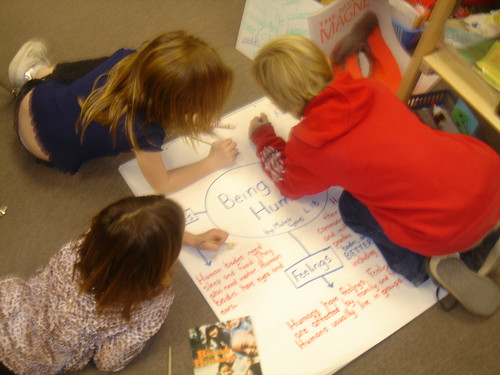
In a constructivist classroom, active teaching methods that require students to think are dominant. Students are taught not "what to learn", rather "how to learn. Teaching techniques like experiments, inquiry, problem solving, open discussion and the like are utilized by the teacher. These are being done because student questions, experiences and interests are given importance, thus there is freedom in sharing questions and ideas to the whole class.

Constructivism is advantageous to learning since learners are actively involved. It concentrates on thinking rather than simple memory or recall. It makes learning personal among the learners since they are given chances to share what they already know or what they have experienced. For this reason, social and communication skills are also developed.
Famous constructivist psychologists include Jean Piaget, Lev Vygotsky, Jerome Bruner, etc. Haist...out of characters...

Motivation from Within: A Key for A Better Learning

Friday, May 14, 2010

     In general, motivation can be defined as: an internal state or condition that activates behavior and give its direction; a desire or want that energizes and direct goal-oriented behavior; an influence of need and desire on the intensity and direction of behavior; and the arousal, direction and persistence of behavior.
Motivation is classified either intrinsic or extrinsic. It is intrinsic when the source of motivation is from within the person him/herself or the activity itself. Motivation is extrinsic when that which motivates a person is someone or something outside him/her.
   There are various theories about motivation. Here are some identified theories that explain the motivation:
1. Psychoanalytic Theory-man's motivation is basically unconscious.
2. Superiority and Compensation Theory-emphasized accentuated feeling of inferiority which lead to compensatory activity and a style of life characterized by achievin a plus situation of superiority.
3. Activation Arousal Theory-highly physiological, this theory emphasized balance between level of arousal and environmental stimulation.
4. Social Learning Theory-an individual's motivation is based on his part experiences wherein a particular behavior is based on the success or failure of previous behavior.
5. Humanistic Theory-man's basic needs are physiological while his ultimate need is the development of his potential in which Maslow calls self actualization.
    Educators suggest that intrinsic motivation, or the force that people do without external rewards, yields more positive effect among the learners. It drives the learners to learn even without something material in return. Understanding the nature of intrinsic motivation will enable teachers to develop activities that will awaken this drive, thus enhances learning.

White(1959) published a paper-evidence that human beings have an intrinsic need to feel competent and that behaviors such as exploration and mastery attempts are best explained by this innate motivation force. Piaget(1952) also claimed that from the first day of life, human beings are naturally inclined to practice newly developing competencies or "schemes", and that practicing new skills is inherently satisfying. In the principle of optimal challenge, competence motivation explains children's efforts only to challenging tasks, tasks that will lead to increased competence.

According to White and Piaget, increasing competence that results from practicing newly developing skills and mastering challenging tasks engenders a feeling of efficacy, sometimes referred to as feeling of competence, similar to achievement and pride. It is in this positive emotional experience that makes mastery behavior self-reinforcing.

Other theories on intrinsic motivation portray human beings as information processors. It claims that humans are predisposed to derive pleasure from activities and events that provide some level of surprise, incongruity, complexity or discrepancy from our expectations or beliefs. Pleasure is assumed to derive from creating, investigating, or processing stimuli that as moderately discrepant. Stimulus that are not all discrepant or novel will not arouse interest, and stimuli that are too discrepant from the individual's expectation will be ignored, cause anxiety or even provoke "terror and flight".

Consistent with the principle of optimal challenge, several studies have confirmed that children's emotional response are most intense when they master moderately challenging tasks, which is most likely to lead to improved competence, results in the most positive emotional experience.

Many studies have demonstrated tilt students who believe they are competent academically are more intrinsically interested in school task than those who have a low perception of their academic ability.

Harter said that students often become less intrinsically motivated as they progress through the school years depending on their perception of their academic competence. It is also important to note that environmental factors such as the influence of parents and teachers are considered crucial in the development and maintenance of intrinsic motivation. Students who are encouraged to develop intrinsic motivation in their early years continue to be intrinsically motivated in subsequent education, thus providing basis for achievement motivation in later years. Harter also suggests that sense of self-worth, fostered by a sense of belonging and being socially supported engenders a generally positive affective and motivational state.

Child Psychology: A Bird's Eye View

Friday, April 23, 2010

I would like to share this article about what Child Psychology is. This is just an overview so I hope that you at least learn from this post...


Child Psychology is the study of psychological processes of children, specifically how these processes differ from those adults, how they develop from birth to the end of adolescence, and how the differ from one child to the next.
From the early times, philosophers have speculated and studied about children. According to Plato, children are born with special talents and that their learning should stress those talents. Aristotle on the other hand proposed methods for observing behavior that were forerunners of modern method.
The modern era of studying children has a history that spans only a little more than a century. A number of major theories along with elegant techniques and methods of study help organize the study about children. New knowledge about children based on observation and testing is accumulating at a breathtaking pace.
In the first half of the twentieth century, a number of theories presented influential view about children. Gessel theorized that certain characteristics of children simply "bloom" with the age because of biological blueprint. To systemically observe children's behavior without interrupting them, he created a photographic dome.
Sigmund Freud's psychoanalytic theory believed that children are rarely aware of the motive and reasons of their behavior and that the rules of their mental life are unconscious. Furthermore, John Watson's behaviorism argues that children can be shaped into whatever society wishes by examining and changing their environment. Later in the twentieth century, Jean Piaget they that children pass through a series of cognitive or thought stages from infancy through adolescence. According to Piaget, children think in a qualitative different manner than adults do.
Despite the attempts to unify the various theories, the field remains dynamic, developing as human understanding of physiology and psychology changes.

Behaviorism: Burrhus Frederick Skinner's Operant Conditioning

Wednesday, April 21, 2010

Burrhus Frederick Skinner or more popularly known as B.F. Skinner is one of behaviorists who believe on the S-R model of behavior. Like the rest of behaviorist psychologists, he concentrated on the observable behavior and external factors in learning. His theory is usually referred to as Operant Conditioning since this focuses on the behavior of an individual operating or instrumental in his/her environment. Sometimes this is also called Instrumental Conditioning. In short, the behavior of an individual is "instrumental" or "operates" that produces consequences. If this is reinforced, then more likely a conditioned response will take place. If punished, then the result will be otherwise. To make this simpler, I will just discuss the 2 major factors about this theory: Reinforcement and Punishment.

Reinforcement is a result that strengthen or increases the chances that a behavior will happen. This can be a positive reinforcer or a negative reinforcer. A positive reinforcer is something that is given or awarded. Examples are when teachers give candies, stars or plus points for very good pupils, or parents bought a new toy or dress for their child who is doing well in school. This can be in any form like toys, food, money and also verbal praises. On the other hand, negative reinforcer is something that is removed. For example, if pupils will be well behaved when the visitors arrived, they will have no test in their good conduct class, or if a child will get a high mark in his exam, he will not wash the dishes anymore. Take note, negative reinforcer is a reward. It is not a punishment.

A punishment is a result that decreases or discourages a certain behavior. For example, a teacher will give extra tasks to accomplish for those who didn't study their lesson, or will not allow the pupils to join in the game if they will be noisy.

Further, there is also the term non-reinforcement or behavior that are not reinforced will probably not be repeated like some pupil minor misconduct extinguished just by ignoring it

Behaviorism: Edward Lee Thorndike's Connectionism Theory

Sunday, April 11, 2010

Connectionism Theory or simply S-R or Stimulus-Response Theory by Thorndike is actually one of the most applied theories of learning. It gave us the three laws of learning in which shall I say, most widely used theory in education. This theory states that learning is the outcome of the relationships between stimuli and responses. These relationships become habits and may be strengthened or weakened depending on the nature and the frequency of stimuli and responses themselves. Don't be confused when I say relationship or bonds. What I mean here is learning or a behavior is formed when we find a certain stimulus meaningful to us or have the strong "connection" that we respond to them. These connections become strong and can be further explained by Thorndike's Three Laws of Learning.

1. LAW OF EFFECT. Connections are strengthened if the consequence or the effect is positive. In short, behavior or learning will take place or be repeated if the result of such action is pleasant. For example, students would want to study more if they know that they will be given a reward or a treat when they will get high grades. On the other hand, connection between the stimulus and response weakens when the effect is negative. For example, students will not be noisy because they know that they will be scolded if they do so. However, Thorndike reiterated that negative consequences do not necessarily weaken the connections, same is true that positive consequences do not always guarantee the recurrence of behavior. For example, students already know the good effects of studying hard, but why is it that some students are still too lazy to study? Teachers impose consequences for those disobedient and naughty students but why are still some students who are "hard-headed"? But in general, this law can be really applied especially in the classroom setting though there might be some exceptions due to certain factors.

2. LAW OF EXERCISE. Practice makes perfect. This is the cliche that could best describe this law. This means that the more you do or practice a certain behavior, then it will be strengthened. Connection becomes strong. However, practice or exercise doesn't strengthened a behavior or performance without feedback. Feedback is necessary especially if we aim for an improved performance or behavior. So, practice with feedback makes perfect. Hehe...

3. LAW OF READINESS. Proper mind set is the key word in this law. This law states that the more "ready" an individual to respond to a stimulus, the stronger will be the bond between them. And, if an individual is ready to respond but is not made to respond, it becomes frustrating and annoying to that person. I would like to have my personal experience as an example. Our schedule for our licensure examination was scheduled September 27. We were very nervous, some are excited, the adrenalin is rushing through our bodies, and we are "ready" for "battle". But, because of the typhoon Ondoy, it was announced on the 26th, the day before the examination, that the test was cancelled and it will be held a week after. Some of us are really annoyed, frustrated, angry and even cried. Of course you know what I mean. This is also true if our board examination will be moved earlier in which we are not yet "ready" to take it. Of course, this is also frustrating and disappointing on our part to take the exam knowing the fact the we weren't ready. Now this is the law of readiness. Hehehe...

Educational Psychology: Behaviorism

Wednesday, March 24, 2010

After Piaget, I would like to tackle on behaviorism. I think this topic really helps us understand more about human behavior in a tangible and more obvious way. In the field of education, these behaviorist theories have a great impact especially in the field of pedagogy as well as understanding the learners. But what is behaviorism in the first place? In the second place? Hehehe. Just kidding. But seriously speaking, what behaviorism really is?
In the most simple term, behaviorism concentrates more on observable and obvious behavior. What I mean is that this theory is more of the behavior that we can see, or the reaction or response of a person on a given situation or stimulus. It suggests that behavior can be learned by conditioning and reinforcements. Reinforcement by the way includes rewards and punishment. It doesn't focus more on the internal factors or the mental processes of humans rather more on the external factors.
There are a lot of behaviorist psychologists and their theories so I will discuss this one by one in the coming posts. I have nothing to do this summer so you might have noticed that I post almost everyday. At least this is a worthwhile pastime because I could have a chance to share what I know to others. Hehehe...


.

Preoperational Stage: Piaget's Theory of Cognitive Development

Saturday, March 13, 2010

   This is the second stage of cognitive development according to Piaget. This includes children who are two to seven years old and probably who are in preschool. The notable characteristic of this stage is that children can now make believe or pretend through the use of symbols. This is called "symbolic function". The most dominant symbol used is language, wherein children represent the objects that they experience through names or words. They can also use a certain object to symbolize or represent something else. Just imagine the tv commercial of a popular milk. The girl was singing something like "Mom said, don't eat your WOOOOOORDS!...She said, I have a beautiful VOOOOOOICE!".hahaha... Well, as you have seen, she was singing using a hair brush as her microphone. She pretended that the hair brush was her microphone. Have you seen your little brother or sister play? The boys especially in which they use sticks as their swords. But as they grow and develop, they can pretend only in their mind even without these objects. Again, imagine you as a child or seeing children play "Power power rangers" or " Good Morning Princess".(Do you know these games?hehe). Those explain it.

     Aside from symbolic function, children have the tendency to be egocentric. It means that they do not assume that each of us has different perspective. They believe that their point of view is the same as with all the people. This is the reason why for example, children have occasional "mine is better than yours" arguements with their agemates or your nephew or niece will ask you why you didn't call his/her mama or papa "mommy" or "daddy".

    Another characteristic of these stage is what we call centration. This can be explained by the experiment done by Piaget himself. In his experiment, he presented a child two identical glasses with the same amount of water. When the child was asked which glass has more water, he answered that both glasses are the same. However, when the water from one of the glasses was transferred to a narrower but taller glass, and was asked again, the child chose that the taller glass has the greater amount of water. This is centration. The child "centered" only on one aspect that is the tallness of the glass without taking into consideration the narrowness of it. This can also be seen when children tend to determine the sex of the people they meet. Boys wear pants while girls wear skirts. Or they will say that a person is already old when they see that that person is wearing glasses, has gray hair or has a mustache, without considering the age or the other details.
  
     Furthermore, children on this stage are very animistic. This is very obvious when they play dolls and stuff toys. And they will say to you not to throw their teddies and handle it with care because teddy might get "hurt". Or seeing a girl telling her agemate not to pick the leaves or the flowers of a plant because the plant will cry.
 
   According to one of our textbooks in college by Corpus, preoperational children has transductive reasoning. For example, if a preschool will be asked why there are no classes, he will probably answer "because it's Saturday." And if you'll ask again, "How did you know that it's Saturday?" He will probably answer "because there are no classes."

     Lastly, children on this stage has still the inability to reverse their thinking. In short, they still don't know that 1+2 is still the same with 2+1. This is the reason why I really had a difficult time explaining to my 6-year old tutee the commutative property of multiplication. That is why I wondered how come this topic was included in an Elementary Mathematics textbook for grade 1. Psychologically, this is inappropriate considering the mental stage of children. However, I thought that the author intended to put this topic maybe in order to help children develop reversibility. This might be true especially with the help of an adult, a teacher or a parent, or an older significant other, children will gradually develop the ability of reversibility.

SensoriMotor Stage: Piaget's Cognitive Theory of Development

This is the first stage of Piaget's Cognitive Development. This stage is from birth to infancy or zero to two years old. As the name implies, this is a stage where humans focus on the movement of muscles and body reflexes. Just imagine a baby and how he/she moves. And notice how baby toys are designed. In this stage, humans still have to familiarize and learn the world through interaction to objects, concrete objects in the environment.
According to Piaget, babies have the ability of "object permanence" or the ability of the child to know that an object still exists even without of sight. So if you show a baby a teddy bear, and then block or hide the teddy behind a cardboard, the baby would still believe that the teddy is there.
So to the parents, or even teachers, they have to provide a stimulating environment that will give the opportunity for the babies to learn his or her environment. Toys that captivate the senses like those with appealing colors, catching sound(not too much for the ear) and texture would be a great help for the development of this stage. But these toys will be useless and even hazardous without guidance of an adult or an older significant other.

Educational Psychology: Piaget's Theory of Cognitive Development

Tuesday, March 09, 2010

This is my very first post about education so I really hope that whoever will read this post can learn a lot and should be able to apply it in their everyday lives, whether they are teachers, educators, parents, students and the like.
Piaget is only one of modern psychologists who influenced the notion of learning most especially about how humans develop mentally. He believes that human mind has what he calls "schema" or mental/cognitive structures. In short, we humans are already born with something in our heads, not as empty vessels waiting to be filled. He also introduced the concepts of assimilation and accomodation. Assimilation is the adding of new experience or learning to an existing or already made schema. Example, if we had a schema of what a fish is, and we saw another fish of different color, then we try to add or fit in that new information to our current schema. And in the process of seeing another kind of fish, then we "accommodate" or create a new schema. As we grow, our minds pass through 4 stages: sensori-motor, pre-operational, concrete operational and formal operational. Each stage has its own characteristics which later I will discuss one by one. I will also tackle the practical applications of this theory especially in pedagogy and instruction.
This is only the introduction of my series of discussion about Piaget and the rest of other educational psychologists. I hope you find this post of mine helpful to your study. And I really hope that whoever got to read my post will tell their friends and classmates and teachers about my blog so that I could extend and share my knowledge about these topics.